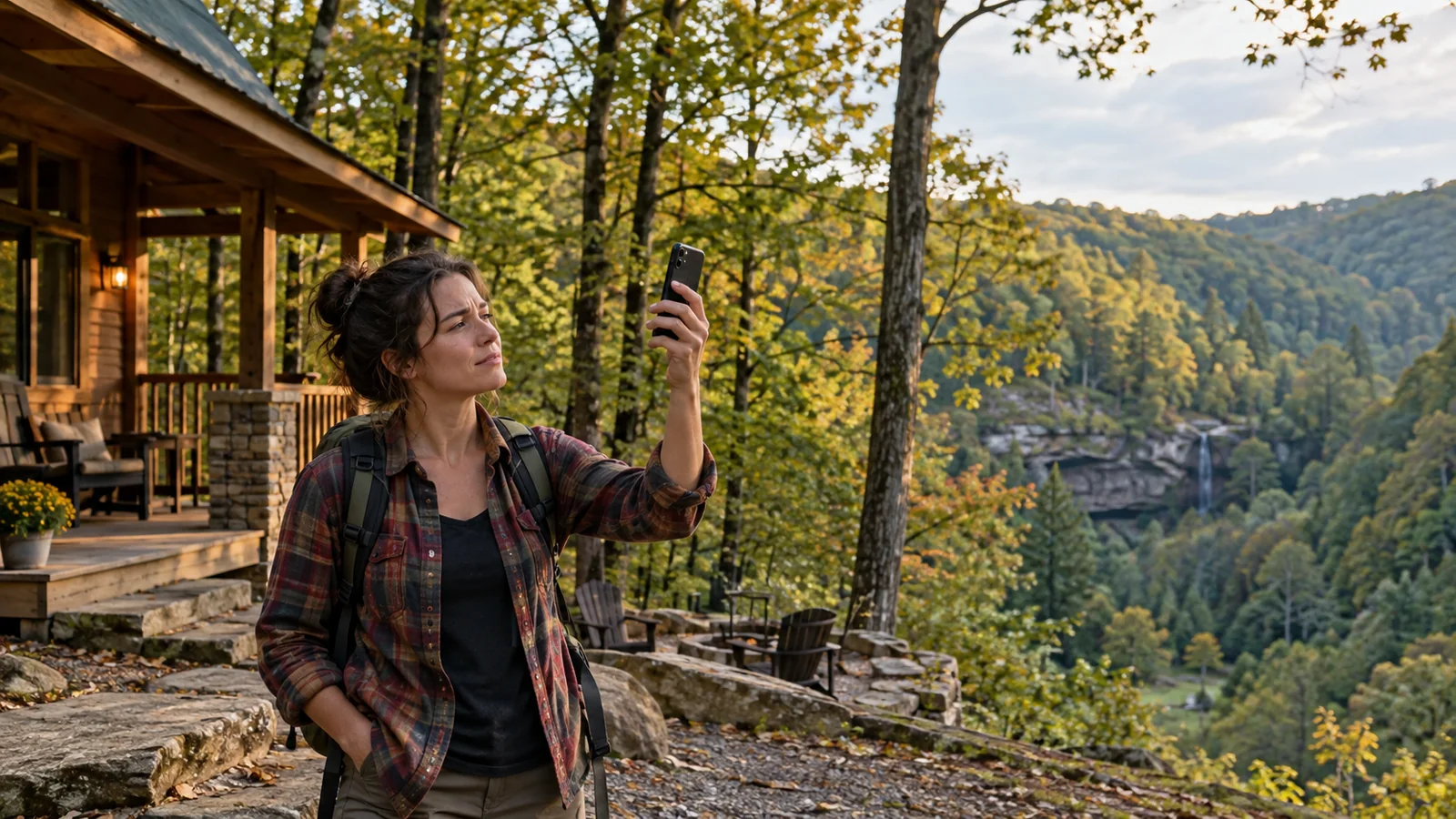
Hocking Hills Cell Service: How to Plan for Dead Zones Before They Become a Problem
Do not make “I’ll just pull it up on my phone” the backbone of your trip. In the hills, the smart plan is to assume service may disappear exactly when you need directions most.
The useful rule: plan for no signal, then be pleasantly surprised
Cell service in Hocking Hills is uneven because the landscape is doing exactly what makes the region beautiful: deep gorges, steep ridges, dense forest, and rural roads. A phone may work normally on one ridge and struggle a few minutes later in a hollow. Carrier maps are useful for broad planning, but they are not a promise at a specific cabin, parking lot, or trailhead.
The safest visitor strategy is simple: assume you will lose data service at some point south of Logan and build the trip so that losing it is inconvenient, not disastrous.
Download the things you normally stream
Before leaving reliable service, save the cabin address, door code, host phone number, and turn-by-turn directions as screenshots. Download an offline map of the Hocking Hills area. Save any trail map you plan to use. If your group is arriving in separate vehicles, decide where you will meet before anyone drives into a dead zone.
The tiny details matter. A gate code buried in an email is not useful if the email will not load. A pin on a map is not enough if the map tiles never downloaded.
Wi-Fi at the cabin is a separate question
A listing that says “Wi-Fi” tells you that the property advertises internet access. It does not tell you whether the connection is fast enough for a video call, stable during bad weather, available on the deck, or backed up if the service drops. If connectivity matters for work, medical call coverage, school, or an on-call job, ask a more specific question before booking.
Useful questions include: What type of internet is it? Has the host tested video calls recently? Is there a speed test from the property? Does the Wi-Fi reach the bedrooms? What is the backup plan if the connection fails?
Do not use cell service as your safety plan
Remote hiking and remote lodging should not depend on one phone having bars. Tell someone where you are going, carry water and basic supplies, and know the park area you are entering. If you are traveling with children or older adults, set a regrouping point in advance instead of assuming everyone can call each other.
This is not alarmist; it is just rural-trip planning. Most visitors have a completely normal weekend. The people who get stressed are the ones who discover the dead zone at the same moment they are trying to find an unfamiliar driveway after dark.
The five-minute pre-drive checklist
Before each drive into the hills: load the route while connected, screenshot the destination, confirm your return route, put the address in every driver’s phone, and make sure the cabin instructions are available offline.
That small habit is more reliable than trying to memorize which carrier “works best,” because reception can change by exact location and conditions.
Find a cabin with connectivity needs noted
Tell us your dates, group size, budget, and what matters most. Your request may be shared with up to 3 relevant participating lodging businesses that appear to fit.
Request lodging matches →Frequently asked questions
Which cell carrier works best in Hocking Hills?
Coverage varies too much by ridge, hollow, road, and exact property to make a blanket promise. Ask the property owner about recent on-site experience and plan for intermittent service regardless of carrier.
Will GPS still work without cell service?
Your phone can still determine location, but map data and routing may fail if the map was not downloaded. Save offline maps before leaving reliable service.
Is cabin Wi-Fi usually enough for remote work?
Sometimes, but “Wi-Fi” is not the same as verified work-grade internet. Ask for the connection type and a recent speed test if remote work matters.
Editorial note: This page is in the publication queue. It intentionally avoids claiming that a specific rental has verified amenities, access, privacy, cell coverage, or availability unless a property has confirmed those details. Time-sensitive information should be rechecked before publication.